
Nucleic Acid Extraction Protocol: An Automation Checklist
Turn your kit instructions into an equipment brief covering manual steps, total processing volume, consumables, program control and evaluation records.
A nucleic acid extraction protocol defines how a particular sample is prepared and purified using specified reagents, equipment and conditions. Moving that method onto an automated extractor requires checking the complete sequence; copying a program name or matching the starting volume leaves important requirements unresolved.
Use the checklist below to turn your kit’s instructions for use into an equipment brief. The MultiEX 032 processes 1–32 samples per run and is one option for that evaluation, with open-system magnetic-bead kit use subject to IFU confirmation. This guide organizes the review; operating instructions remain specific to the selected method.
Identify the exact method before selecting a program
Record the kit manufacturer, catalog number, IFU revision, sample matrix and intended downstream application. Identify the manual or automated procedure within that document; a single kit can have more than one method.
For example, the Thermo Fisher total nucleic acid extraction user guide gives separate manual and automated instructions and specifies work outside the instrument. The example shows why method identity matters; it does not validate that kit for MultiEX.
Keep the source document with the evaluation record. If the kit instructions or instrument program are revised, record what changed and have the method owner determine the necessary review.
For a whole-blood project, the automated DNA extraction from blood guide adds a sample-specific checklist for blood fraction, collection history, working volumes and the supplier brief.
Use the extraction stages as a map
Magnetic-bead workflows can be described conceptually as preparation, binding, washing and elution. The chemistry and operating conditions belong to the particular kit and sample.
- Prepare Follow the kit's sample preparation and lysis instructions.
- Bind Use the specified chemistry to bind nucleic acids to beads.
- Wash Separate bead-bound material and remove contaminants.
- Elute Release nucleic acids into the specified final buffer.
For each stage, identify the task, its location and its owner. Ask the supplier to show where the proposed instrument program begins and ends, including any prompts that require operator action.
| Stage | Requirement to extract from the IFU | Equipment question |
|---|---|---|
| Sample preparation | Disruption, lysis or other required preparation | What equipment and bench work are required before loading? |
| Binding | Reagents, bead preparation and mixture requirements | Can the proposed program and vessel carry out this stage? |
| Washing | Wash sequence and separation requirements | Which processing positions and consumables are needed? |
| Elution | Buffer, volume and required handling | Where does the output go, and what transfer remains? |
| Additional treatment | Any method-specific treatment or cleanup | Is it included in the program or performed separately? |
Our magnetic-bead principle guide explains the conceptual stages. For equipment selection, the useful next step is to annotate them with the actual kit requirements.
Calculate total processing volume at each stage
Record both the raw sample input and the largest working mixture. Reagents added during preparation or binding can make the processing mixture larger than the starting sample.
As an illustrative calculation, 200 µL of sample plus 500 µL of added reagents gives 700 µL before any further additions. This is arithmetic for a planning worksheet, not a recommended extraction recipe or confirmation that a particular vessel or program accepts that mixture.
Ask the supplier to check every stage against the vessel’s working limits and the instrument configuration, including the space needed for the prescribed processing action. A nominal capacity or starting-volume number is not a complete fit check.
Manufacturer-stated MultiEX processing ranges are:
| Model | Samples per run | Processing-volume range per sample |
|---|---|---|
| MultiEX 016 | 1–16 | 50–1000 µL |
| MultiEX 032 | 1–32 | 50–1000 µL |
| MultiEX 096P | 1–96 | 50–1000 µL |
| MultiEX 024L | 1–24 | 50 µL–8 mL |
These are equipment specifications, not approved sample inputs for every kit. Use the model comparison to separate standard-volume batch capacity from the large-volume tier.
Match the consumables and program to the method
Ask for the proposed plate or strip, magnetic rod sleeve and output container identifiers. Have the supplier confirm the required configuration rather than treating a common plate-format description as sufficient.
The NEB viral extraction manual’s automation guidance explicitly links hardware, scripts, processing steps and compatible plastics. It is a useful example of the relationships to document, not a source of universal settings for other kits or instruments.
For the program record, capture its identifier and version, the corresponding IFU and the person responsible for approving changes. Ask how an operator selects the correct version and how the lab will distinguish an evaluation program from one released for routine work.
If a required stage is absent, resolve that gap before ordering. An editable program does not by itself establish that a particular chemistry or sample has been evaluated.
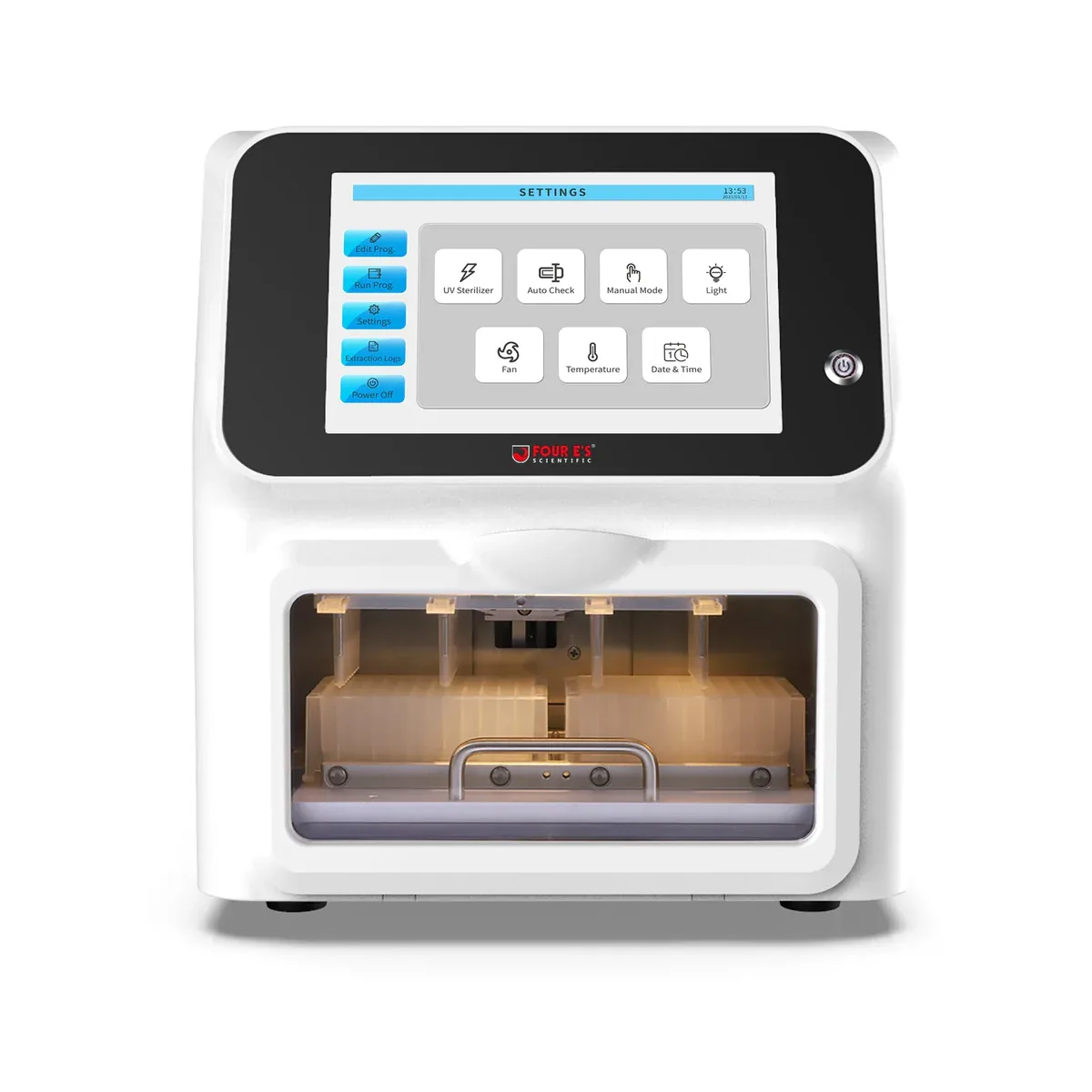
For a mid-throughput workflow, request a MultiEX 032 purchase configuration and attach or identify the kit instructions you want the supplier to review.
Apply the checklist to your sample workflow
Use the method’s preparation and output requirements to choose the relevant buying questions:
- Use wastewater extraction equipment planning to separate concentration, prepared lysate and processing volumes.
- Use environmental DNA equipment planning to distinguish water filters, concentrates and soil preparation.
- The plant and seed extraction buying guide separates disruption and lysis from automated purification.
- The food extraction automation buying guide starts with the analytical target and food matrix.
- The veterinary extraction equipment guide organizes sample, target and kit-packaging questions.
- Use microbiome extraction automation planning to distinguish cell disruption from magnetic purification.
- The NGS extraction equipment buying guide works backward from library input and output-handoff requirements.
- The biobank and CRO extraction equipment guide adds mixed-project and sample-to-eluate records.
- The FFPE extraction planning checklist defines the preprocessing boundary and downstream quality requirements.
- The forensic extraction equipment checklist distinguishes sample classes, control purposes and identity records.
- Use biopharma extraction equipment planning to define assay and process-matrix requirements.
These guides organize equipment questions. A shared checklist does not establish that one kit, program or instrument configuration fits all of those methods.
Agree on the evaluation record before a trial
Decide what the laboratory needs to observe and document before comparing results. The acceptance criteria should come from the method owner and downstream requirements, not from a generic equipment checklist.
Record the sample and control layout, kit and reagent lots, program version, consumables, preparation steps, interventions and any departures from the planned method. Capture the output checks and downstream observations required by the evaluation plan.
Keep timing observations in separate stages: preparation, loading, instrument run, unloading and handoff. This makes it possible to compare workflow changes without presenting instrument run time as the entire preparation time.
Send a brief that can produce a useful quote
Include the complete routine batch, peak workload, sample matrix, kit and IFU revision, raw input, largest processing mixture, elution requirements and downstream vessel. Add the desired purchasing timeline and ask for the current datasheet, consumable list and proposed configuration.
The open-system buying checklist covers the supplier discussion. If you are still choosing a capacity tier, submit a purchase inquiry with the workflow brief and the models under consideration.
Is there one nucleic acid extraction protocol for all samples?
No. Use the instructions for the specific kit, sample and target. Shared conceptual stages do not make reagent amounts, temperatures, mixing or timing interchangeable.
Does open system mean a kit works without further review?
No. Confirm the kit IFU, sample, program, processing volumes and consumables with the supplier. Keep the resulting evidence with the laboratory’s method evaluation.