
Viral Nucleic Acid Extraction: What to Check Before Automation
Specify sample matrix, transport medium, controls and kit requirements before comparing MultiEX batch capacity and requesting equipment.
Viral nucleic acid extraction isolates DNA or RNA for a downstream analytical method. Before automating it, define the sample, transport medium, extraction kit and controls; a suitable batch capacity alone does not establish that an instrument-kit combination meets the method’s requirements.
The MultiEX 032 offers 1–32 samples per run for a mid-throughput equipment shortlist. Evaluate the proposed magnetic-bead kit and program with the supplier first. For larger batches, the MultiEX 096P offers 1–96 samples per run, subject to the same method-specific review.
Start with the sample and target together
Specify whether the workflow requires viral DNA, viral RNA or total nucleic acid. Pair that requirement with the exact sample matrix, collection container and transport-medium formulation.
The NEB viral DNA/RNA extraction manual illustrates why these details matter: it identifies particular starting materials and transport-media considerations, rather than treating every swab or liquid sample as equivalent. It also discusses an internal control added before extraction and carrier RNA considerations. These are kit-specific examples, not evidence of MultiEX compatibility.
Prepare a separate method brief when the sample matrix or transport medium changes. Ask what documentation or evaluation is needed for the new combination instead of assuming an existing program covers it.
Separate extraction from the downstream result
Extraction prepares nucleic acid; the downstream analytical procedure determines what is measured. An equipment specification does not supply the assay’s acceptance criteria, detection limit or interpretation rules.
Keep the workflow stages explicit:
- Prepare Follow the kit's sample preparation and lysis instructions.
- Bind Use the specified chemistry to bind nucleic acids to beads.
- Wash Separate bead-bound material and remove contaminants.
- Elute Release nucleic acids into the specified final buffer.
The figure is a conceptual map. It does not specify a viral processing method or establish which preparation stages occur on a proposed instrument. The selected kit instructions and laboratory procedure determine those details.
For a purchasing discussion, identify the boundary of automation. Ask which preparation, loading, transfer and output-handling tasks remain outside the extractor. Include those tasks in the trial schedule and staffing plan.
Document what each control is intended to assess
List the controls required by the laboratory method and record where they enter the workflow. A control introduced after extraction cannot, by itself, assess the preceding extraction stages.
Use this table to organize the discussion with the method owner. The actual materials, placement, frequency and acceptance limits must come from the documented procedure.
| Control question | Information to record |
|---|---|
| Is background or carryover being assessed? | Required blank or negative extraction-control material and its assigned position |
| Is extraction being monitored? | Control identity, point of introduction and what its result can assess |
| Is the downstream assay being assessed? | Assay control identity and whether it also passes through extraction |
| Are results acceptable? | Method-specific acceptance criteria and action for an unacceptable run |
Count the required controls as part of the extraction batch when they occupy processing positions. Preserve their identifiers and locations in the run record so the output can be reconciled with the source layout.
If a control fails, investigate through the kit supplier, assay documentation and laboratory quality process. Equipment purchase guidance does not replace the method’s troubleshooting or result-release procedure.
Review program, plastics and volume requirements together
Ask for the exact proposed program and processing consumables. The Thermo Fisher automated viral extraction manual provides an example of workflow-specific hardware, program and plate requirements; those settings should not be transferred into a different platform by assumption.
For MultiEX, open-system design for magnetic-bead kits still requires kit IFU confirmation. A kit described as automation-ready is a starting point for a configuration discussion, not blanket confirmation of a particular instrument, program or sample.
Bring these questions to the supplier:
- What evidence supports the proposed kit, sample and instrument combination?
- What is the total processing mixture at each stage, including added reagents?
- Which plates or strips, rod sleeves and output vessels are required?
- Which stages are automated, and what operator interventions remain?
- What evaluation records should the lab obtain before routine use?
Use the open-system compatibility checklist to organize the response and the protocol planning guide to map the method to the equipment.
The viral extraction equipment overview provides the commercial model-selection path once these method requirements are defined.
Shortlist capacity after defining the method
MultiEX 032 and 096P both list a manufacturer-stated 50–1000 µL processing-volume range per sample. Confirm how the required sample and reagent mixtures fit that range; do not treat the range as an approved raw input volume for every viral kit.
| Routine requirement | Equipment option to evaluate |
|---|---|
| Up to 32 total extraction positions | MultiEX 032, after including controls and required replicates |
| Larger batches up to 96 positions | MultiEX 096P, after reviewing preparation and downstream capacity |
| A method outside the proposed volume or consumable requirements | Revisit the equipment configuration before purchase |
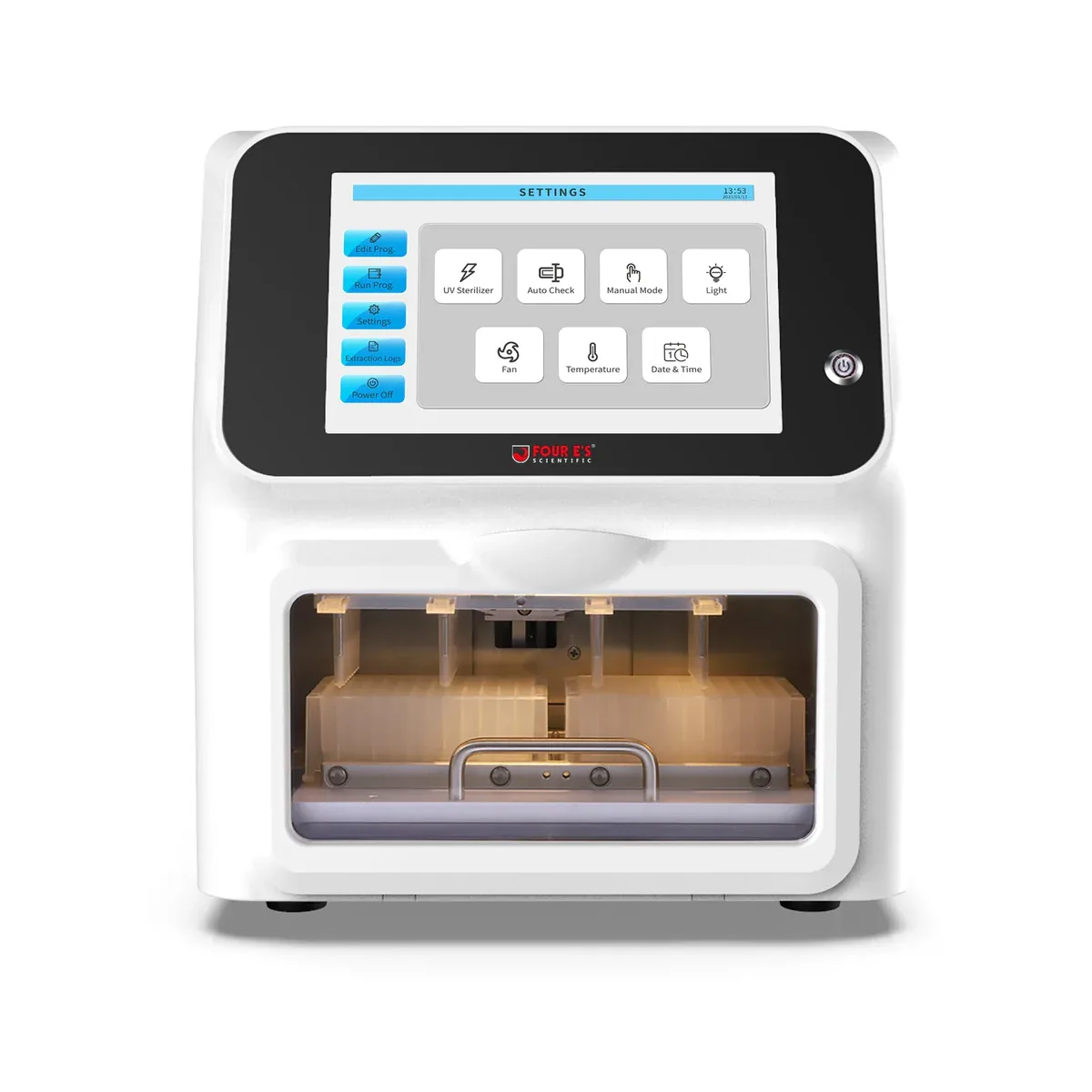
For a mid-throughput shortlist, submit a MultiEX 032 purchase inquiry. Send the method brief and ask for the current datasheet, proposed program, required consumables, availability and quote.
Frequently asked buying questions
Can one extraction method cover viral DNA and RNA?
Some kit instructions describe total nucleic acid extraction, while other workflows have a different target requirement. Identify what your selected kit recovers and what the downstream procedure requires; do not infer this from the extractor’s name.
Does a larger batch establish better analytical performance?
No. Batch capacity describes how many samples the equipment processes per run. Analytical performance belongs to the evaluated sample, kit, program and downstream method.
What should a larger lab request?
Provide the total batch, arrival pattern, controls, kit and IFU revision, sample and transport medium, output requirements and purchase timeline. Request a MultiEX 096P configuration when the larger capacity fits the proposed workflow, and keep any application-specific suitability questions in the inquiry.