
Automated RNA Extraction: Plan the Workflow Before You Buy
Map sample handling, DNA removal and eluate requirements, then compare MultiEX capacity for your lab's next equipment purchase.
Automated RNA extraction can move binding, washing and elution onto an instrument, while sample preparation and final handling may still require bench work. If those stages are missing from the equipment brief, a lab can buy enough nominal capacity and still leave its main bottleneck unresolved.
Start with the RNA method and the complete batch. The MultiEX 032 processes 1–32 samples per run and is a mid-throughput option to evaluate against the selected kit; the MultiEX 096P processes 1–96 when a larger batch is required. Confirm the proposed RNA protocol and consumables before choosing either.
Define which RNA the method must recover
An RNA equipment inquiry should identify the target, sample matrix and downstream application together. “RNA extraction” alone leaves too much unspecified for a useful configuration discussion.
Use the following questions to make the requirement concrete:
| Requirement | What to put in the method brief |
|---|---|
| Target | Total RNA, a selected RNA fraction, viral RNA or cell-free RNA |
| Starting material | Sample matrix, preservation method and kit-supported input |
| DNA handling | Whether DNA must be removed, retained or assessed separately |
| Output | Required elution buffer, volume and collection vessel |
| Next step | RT-qPCR, sequencing preparation or another documented application |
Different RNA methods can include different treatment stages. For example, NEB’s magnetic cfRNA documentation describes an on-bead DNase step and automation scripts for select platforms. This illustrates why DNA removal and script availability belong in the requirements; it does not establish compatibility with MultiEX.
Keep the kit name and instructions-for-use revision with this brief. A change in target or sample preparation should prompt a fresh method review, even if the instrument remains the same.
Map the work before, during and after the run
Ask who performs each stage and where it happens. A useful workflow map begins with the preserved sample and ends when the eluate reaches the next procedure, rather than beginning at the instrument’s Start button.
Before the run: identify sample preparation, reagent preparation, labeling and loading tasks. During the run: identify the steps assigned to the instrument and any operator intervention. After the run: identify collection, storage, quality checks and transfer into the downstream workflow.
The NEB RNA purification guidance emphasizes RNase-conscious work areas and consumables, sample-specific preparation and appropriate handling of purified RNA. Its instructions are for its own kit; do not transfer its temperature or incubation settings into another method.
Use the map to ask a practical purchasing question: which task is limiting the lab today? If the delay is sample preparation, increasing extraction capacity alone may not resolve the queue. If the delay is repeated small extraction batches, a larger instrument may deserve evaluation.
Locate DNA removal in the proposed program
Write down whether the method needs a DNase treatment and whether that treatment occurs on the instrument or at the bench. Include any associated wash, cleanup or transfer steps in the schedule.
NEB’s RNA handling guidance discusses DNase treatment when genomic DNA removal matters for the downstream application. That is a reason to consult the selected method, not to add an unspecified DNase step to every RNA program.
For a purchase discussion, ask for the proposed program identity, the treatment stage it includes and the documentation supporting the complete sequence. A program labeled “RNA” is not enough information to determine that it meets the lab’s DNA-removal requirement.
Specify the eluate handoff
Define the output the next procedure needs before selecting the extraction configuration. Ask the downstream team to specify usable volume, buffer requirements, container format, storage and any acceptance checks.
Make the handoff visible in the trial plan. Who removes the output, records its identity and makes the next transfer? Does the next procedure start immediately, or does the batch wait for another operator or instrument?
These questions also help separate equipment capacity from method performance. A full extraction batch is useful only when its output can enter the next stage under the lab’s documented requirements.
Compare MultiEX capacity against the complete batch
If an existing RNA workflow is producing unexpected results, first use the RNA extraction troubleshooting guide to separate measurement, integrity and method questions from equipment capacity.
The MultiEX 032 and 096P both have a manufacturer-stated 50–1000 µL processing-volume range per sample. That equipment range does not establish the allowable raw input for a particular RNA kit; check the total mixture and each processing stage with the supplier.
| Equipment option | Manufacturer-stated capacity | Main purchasing question |
|---|---|---|
| MultiEX 032 | 1–32 samples per run | Does the complete routine batch fit after controls and planned repeats? |
| MultiEX 096P | 1–96 samples per run | Can preparation and downstream work support the larger extraction batch? |
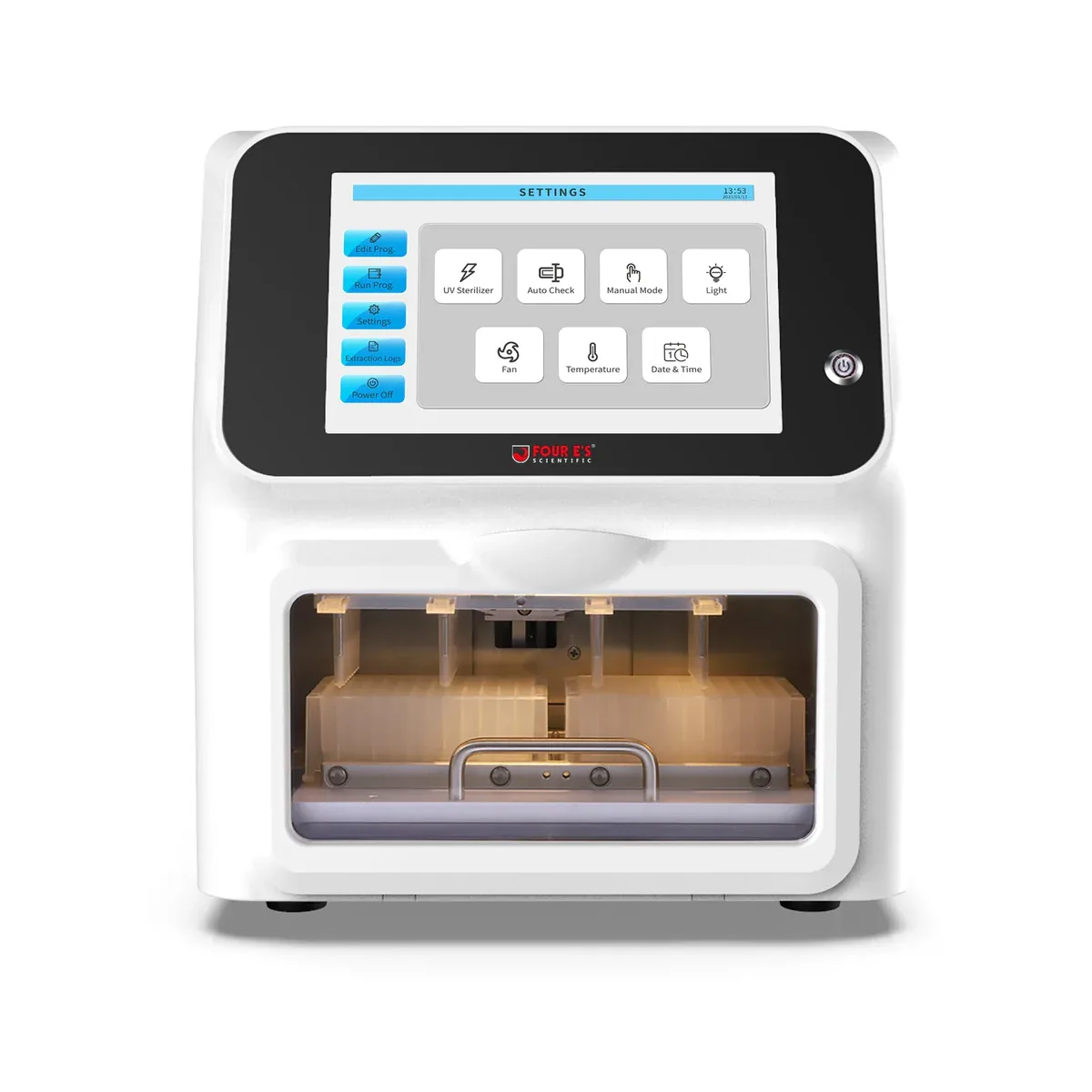
Both use open-system magnetic-bead positioning, with kit IFU confirmation required. Review the RNA extraction system guide and model comparison when shortlisting equipment.
If a 32-sample configuration appears suitable, submit a MultiEX 032 purchase inquiry with the RNA target, kit and complete batch requirement. Ask for the proposed program and consumable configuration alongside the quote.
Questions to settle before ordering
Does automated RNA extraction remove every manual step?
The extent of automation depends on the documented workflow. Have the supplier identify sample preparation, reagent setup, instrument stages and final transfers individually.
Can a DNA extraction program be used unchanged for RNA?
Do not assume so. Check the RNA kit’s preparation, DNA-removal and handling instructions against the proposed program. Our DNA versus RNA extraction guide explains the questions to review.
What should an equipment inquiry include?
Send the sample matrix, RNA target, kit and IFU revision, input and elution requirements, total batch, downstream workflow and purchase timeline. For larger batches, request the MultiEX 096P configuration; capacity and method suitability should be reviewed together.